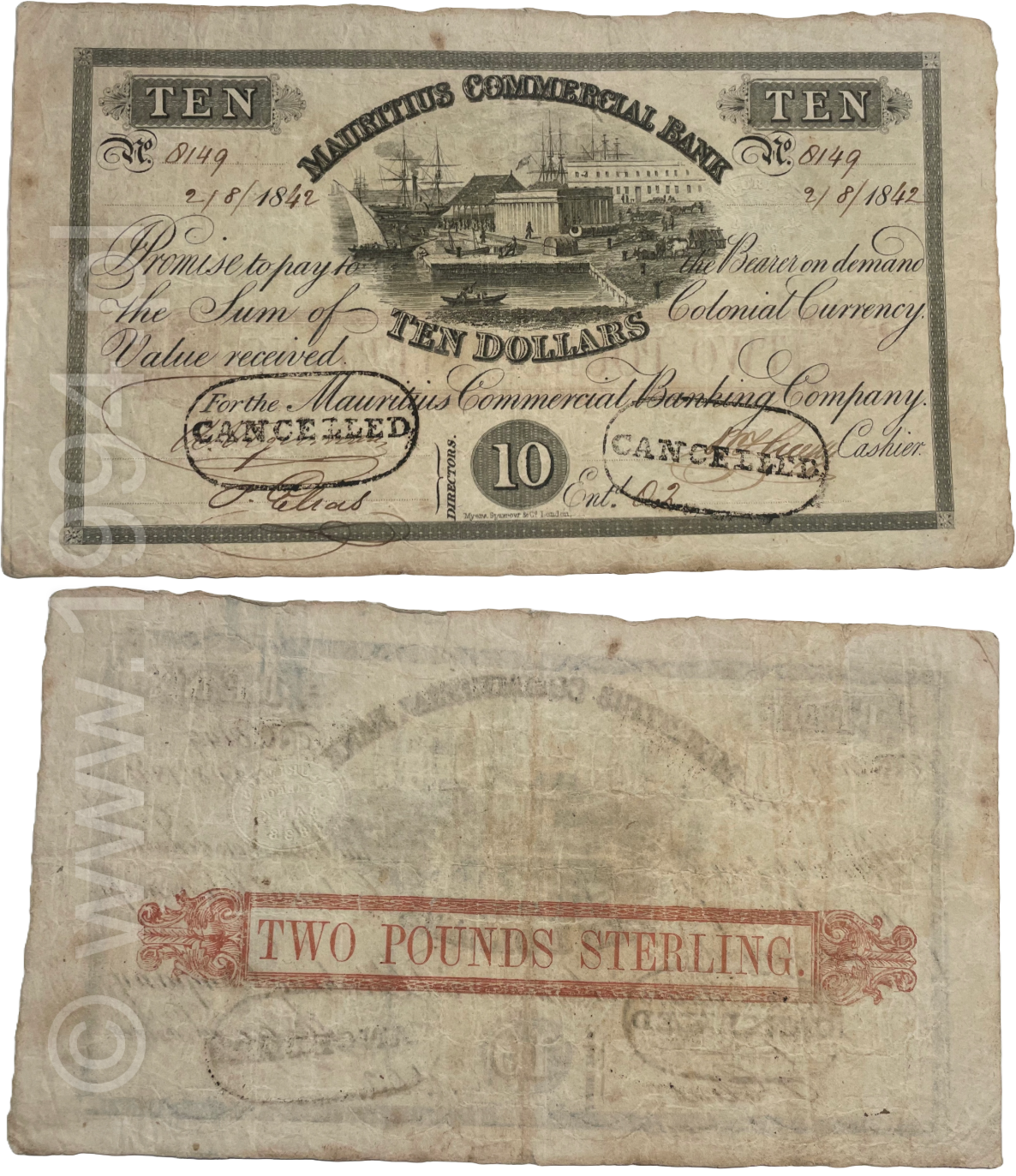
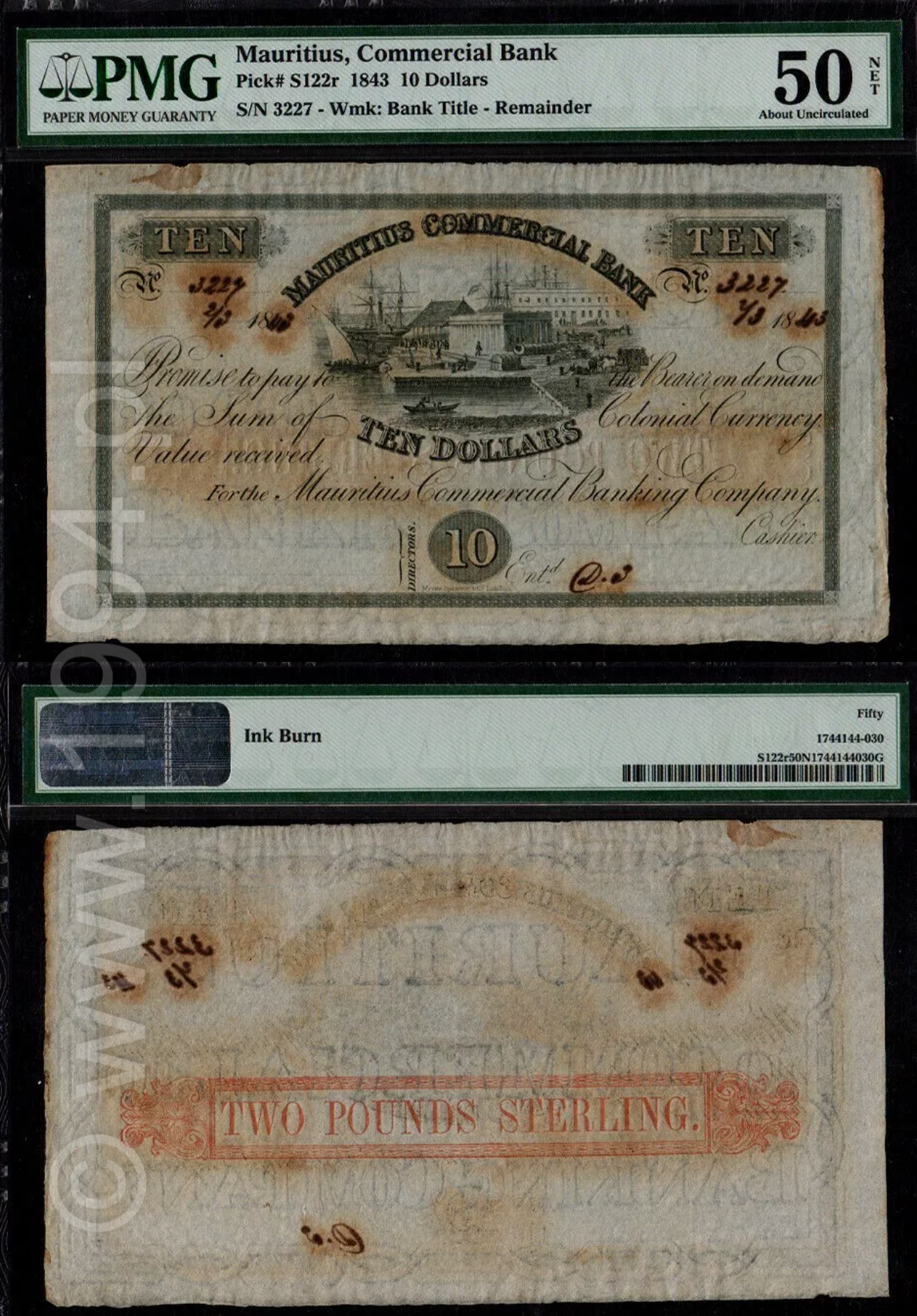
Mauritius 1843 - Mauritius Commercial Bank 10 Dollars / 2 Pounds Sterling Remainder (Pick S122r)
Unissued remainder from the earliest Mauritius Commercial Bank dual-currency series, printed by Myers Frs. & Co., London. Read more →
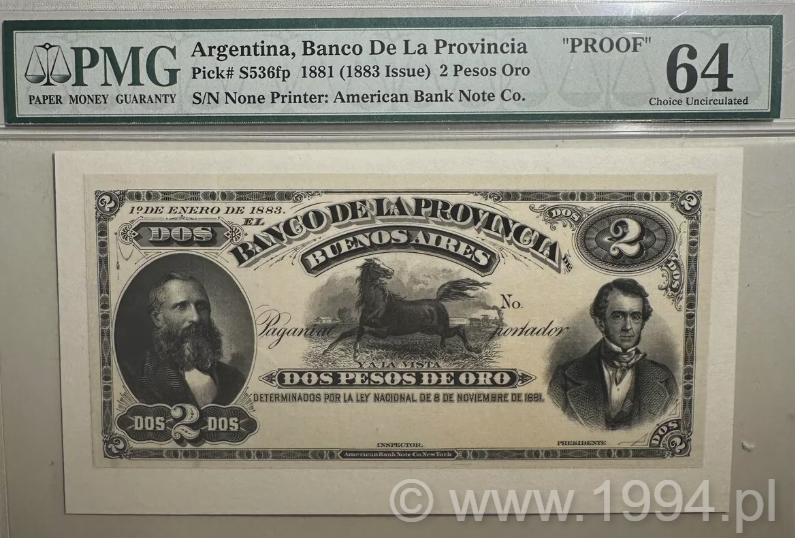
As a period ABNC India-paper proof, this piece captures the engraving exactly as it existed on the master plate before tint stones, serialing, or final production adjustments. Such proofs were archived by both the printer and the bank, used as reference material, and later preserved in private collections after the dispersal of ABNC archives. Survival of a single proof of this denomination-especially at PMG 64 Top Pop-marks it as a museum-grade artifact documenting the peak of American engraving influence in South America and the early evolution of Argentina's 'Pesos Oro' monetary standard. Read more →
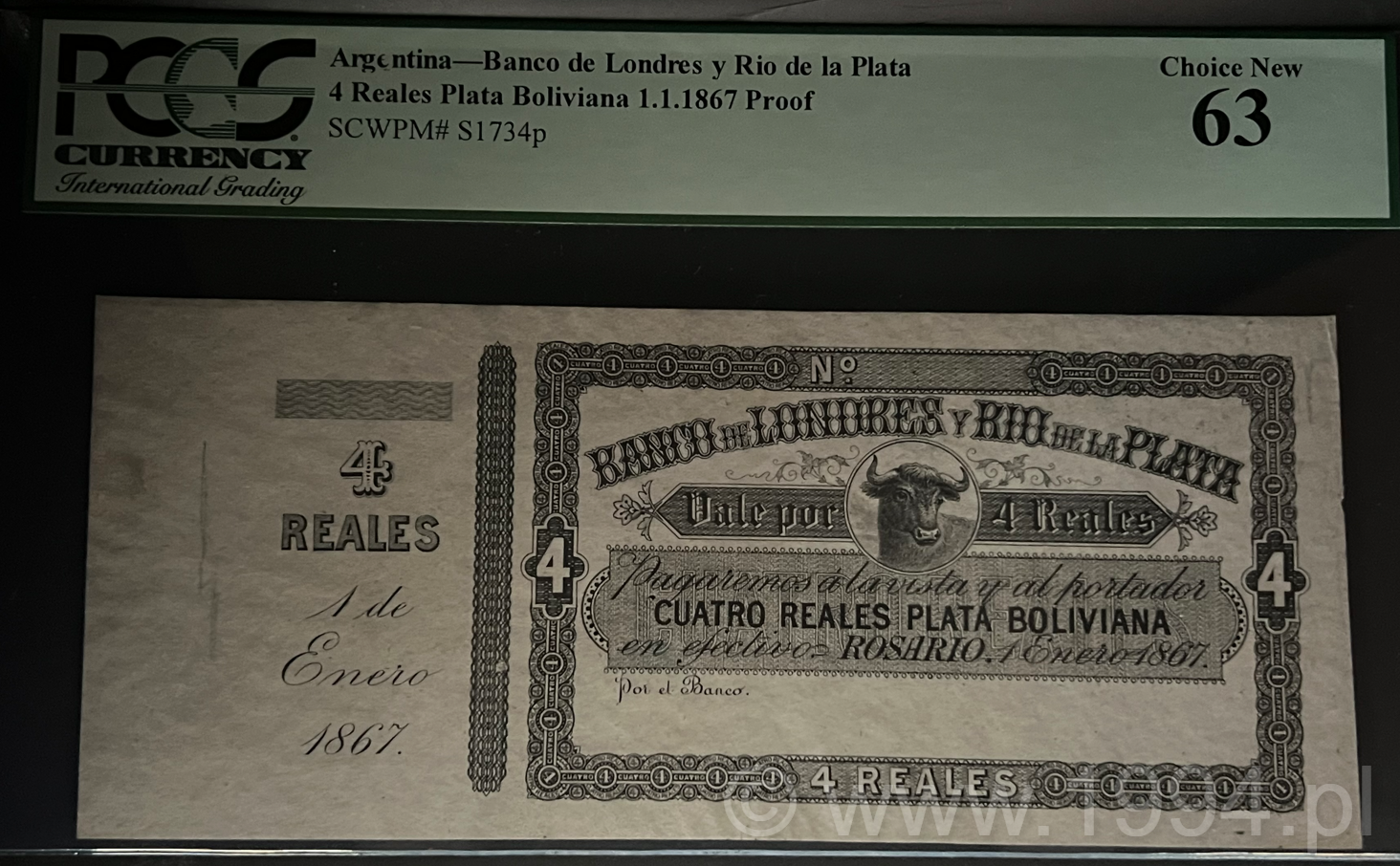
Beyond its printed details, this piece captures a rarely told chapter of Argentina’s monetary adolescence. In 1867, provinces like Santa Fe and Entre Rios were still using a cocktail of currencies - reales, pesos bolivianos, private banknotes, merchant drafts, and foreign coin. The Banco de Londres y Rio de la Plata stepped into this fragmented environment with the explicitly British strategy of stabilizing trade routes and agricultural exports through reliable convertible paper. This little 4 Reales note represents the bank’s attempt to impose order on a chaotic frontier economy, where a single cowhide or sack of grain could be worth more than the entire circulating paper stock. Read more →
The Banco de Londres y Rio de la Plata, incorporated in London in 1862, operated as a British controlled private bank with branches in Buenos Aires, Cordoba, Rosario, and Montevideo. The Rosario branch, established in 1867, functioned within a rapidly expanding grain export and river trade corridor, while operating under persistent tension with provincial authorities and competition from locally controlled institutions such as the Banco Provincial de Santa Fe. Read more →
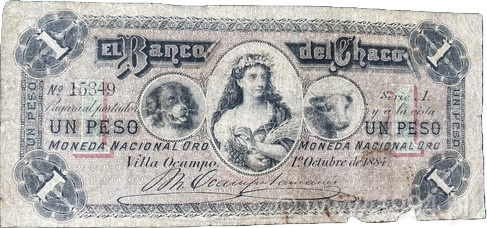
Rarity: the entire PMG census lists only two graded examples of Pick S1566 (VF 10 and VF 15). With both serial 05056 (fragmented) and 15849 (complete) now documented in this collection, they represent the only illustrated and confirmed survivors. This fragment therefore stands as a research cornerstone for the type, bridging catalog theory and tangible evidence of one of Argentina’s rarest 19th-century provincial notes. Read more →
Unlike the larger banks of Buenos Aires or Córdoba, El Banco del Chaco operated on razor-thin reserves and depended heavily on the unpredictable rhythms of northern agriculture. A provincial note from this region is far scarcer in any condition, because almost none were set aside. Local economic instability and periodic bank failures ensured that issued notes were redeemed, cancelled, or destroyed-making worn survivors vastly rarer than high-grade proofs from other provinces. Read more →
The obverse design follows the classic American Bank Note Company international style of the mid-nineteenth century. At left, two allegorical female figures personify Commerce and Abundance, rendered in finely engraved classical style. At right, the national coat of arms of Uruguay appears above crossed flags and laurel branches, emphasizing state authority and political legitimacy. A bold central orange guilloche surrounds the inscription “UN DOBLÓN DE ORO SELLADO,” explicitly referencing gold-backed value and convertibility, an essential confidence mechanism in Uruguay’s developing monetary system. Read more →
The dual-signature configuration represents a short-lived administrative experiment within the Banco Oriental. It was introduced after the original single-signature format and abandoned before the adoption of mechanically printed facsimile signatures. The rapid implementation and reversal of this requirement strongly suggests heightened oversight or institutional uncertainty rather than a planned production standard. Read more →
Serial number 35345 is distinguished by a single handwritten circulation signature placed centrally within the designated signature area. This centered placement differs from both the original right-side handwritten signature format and the later right-side facsimile signature format. Its positioning reflects a deliberate layout adjustment following the abandonment of the dual-signature authorization model. Read more →
This example is identified as plate position pp C. While Paper Money Guaranty does not formally define plate position distinctions within the Pick catalog, such annotations document internal production differences and demonstrate that distinct plate positions were employed across successive authorization states. Read more →
Graded PMG 64 EPQ, this example ranks among the finest recorded for the type. It represents the approved master proof of Uruguay’s first internationally engraved banknote-where London’s precision met Montevideo’s new financial identity. Read more →
Unlike later engraved security issues produced by specialized banknote printers, the 1866 emission belongs to the earlier typographic tradition of bank vales. The design relies on ornamental typographic borders repeating the word "REAL" around the frame, with the denomination centered within a circular medallion. A large manuscript text panel carries the payment promise and place of issue, emphasizing clarity and immediate recognition in active commercial environments. Read more →